Reversi gets surprisingly deep once you start trying to improve. I develop Reversi AI algorithms and have worked with data from thousands of games — here are the common traits of strong play that emerged from that data.
Data from Thousands of Matches Reveals 'High-Value Moves'
In rough numbers, the trends looked like this:
- ① Corner Value: Around 67 Points
- ② Edge Value: Around 0 Points
- ③ Squares Adjacent to Corners: Around -40 Points
- ④ Each Valid Move Gained or Lost: Up to 7.5 Points
The high value of corners confirms the well-known strategy that placing your discs in corners is generally effective.
Conversely, squares adjacent to corners (especially X-square moves) are considered quite disadvantageous. Playing carelessly in these squares often leads to giving your opponent the corner, so they should be avoided unless there is a specific strategic reason.
Edges are often thought to be 'strong,' but when viewed in isolation, they hold little value. In fact, if you cannot secure the corners, there is even a risk of them being taken back later, increasing your opponent's stable discs.
And surprisingly important is not 'how many discs you can flip right now' but 'how many valid moves you'll have next.' I personally found that prioritizing this over disc count in the early to mid-game improved my win rate.
Phase-by-Phase Strategy
Early Game: Flip Fewer Discs — Quiet Moves Work
In the early game, it's tempting to flip lots of discs, but what actually wins games is having more places to play while limiting your opponent's options.
An effective tactic for this is the 'quiet move'. Specifically, it involves slipping a disc into your opponent's cluster of discs to create a shape where only you can extend to either side next.
The early game also has some established opening lines — for example, the Rabbit and the Tiger. You don't need to memorize every line; knowing a few common patterns makes things much easier.
Midgame: The Battle for Corners
As you enter the midgame, how you handle the corners can change the flow of the game.
In the battle for corners, handling moves known as 'X-square' and 'C-square' is crucial. Here is a brief explanation.
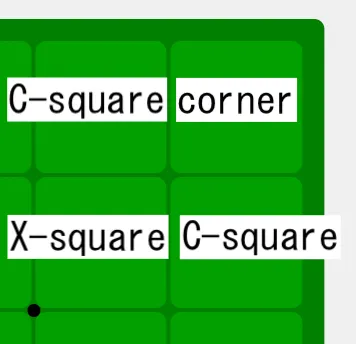
What is an X-square move?
An X-square move is a placement diagonally adjacent to a corner. Since it carries a high risk of allowing your opponent to take the corner, it should generally be avoided.
What is a C-square move?
A C-square move is a placement adjacent to a corner along the edge. Similar to an X-square move, it carries the risk of allowing your opponent to take the corner, but it can be a viable escape when there are no better options.
Endgame: Build Stable Discs and Read to the End
As you approach the end of the midgame, focus on 'stable discs'.
What are Stable Discs?
'Stable discs' are discs that can never be flipped again. For example, discs along the edge next to a corner you've secured become stable discs, because your opponent can no longer flip them.
Additionally, in the endgame, you can carefully analyze and look ahead several moves into the future.
While 'reading to the end to win' may sound daunting, endgame positions are limited, so with some effort you really can read all the way to the end.
To practice reading out the endgame, try our free daily Reversi puzzles, seven a day. Each starts from a set position and you play to the end to win, from Beginner (2–3 empty squares) to Transcendent (16).
Practice with AI Matches
On this site (Reversi Web), you can play against Reversi AI for free.
A wide range of difficulty settings are available, and you can also play online matches with family, friends, and players around the world. Try it here:🎮️ Play Reversi